A Mattress Maker in the Faubourg: Episode 4
Published:
Updated:
Author: Patrice Sébille
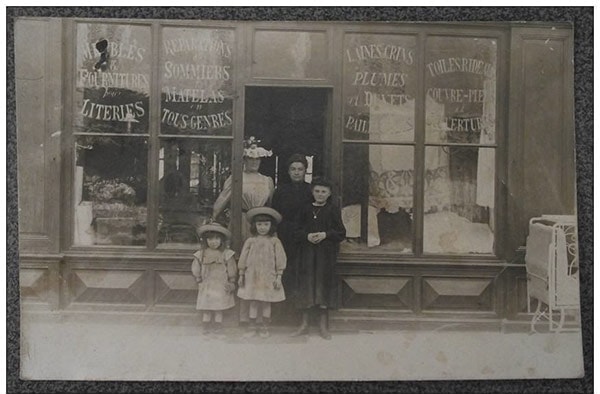
The establishment was called Le Jean Bart. Long a café and tobacco shop, it had become an ordinary café a few years earlier.
Seven or eight years earlier, the new manager had simply stopped selling cigarettes. It had driven away quite a few drunks and troublemakers, he explained. And indeed, when I first walked in, I was won over by its relative calm.
At the very beginning of my troubles—the same troubles that led to the loss of my job—I was so optimistic that I felt certain they would be over in an instant. So I had hidden them from my children.
Later, when the situation proved more lasting, there was no way to go back. The charade therefore continued: as far as everyone was concerned, I was at work during the day.
An unforeseen difficulty arose directly from that lie. I had mountains of files and paperwork of every kind to find, assemble, study and complete… yet I simply had no office.
With the primary school day lasting as long as it did, returning home was out of the question, and Jacques’s office was still his own. One day, necessity prevailed, and I settled into the first bistro I came across.
Until then I had disliked coffeehouses and only visited them when I had to. This one lived down to my expectations: dirty, reeking of stale tobacco and lit by a sickly light. I could not even concentrate.
The next day I tried another place, to no avail. Then chance led me to turn left rather than right as I left the alley one day. I had found my “annex”: Le Jean Bart.
In most manual trades, the “annex” was an important place. But in the Faubourg Saint-Antoine, it seems to have mattered even more than elsewhere.
According to the old-timers’ memories—and the archives appear to confirm it—there were so many coffeehouses along the Rue de Montreuil that dozens stood between the Cité de l’Ameublement and the subway. Admittedly, there were customers enough to fill them.
In the years immediately after the Second World War, the Cité de l’Ameublement was home to more than two thousand Parisian craftspeople and employees. At the end of each afternoon, when work let out, the uninterrupted stream of people recalled a film by the Lumière brothers.
As time passed, I made myself comfortable. Almost imperceptibly, my visits to Le Jean Bart became regular and completely unrelated to my need for a table and chair at which to write.
I began to form connections with several regulars who had been coming there far longer than I had. Tentatively at first, then little by little, I was admitted into the informal society that gathered at the bar every morning for an espresso.
Beyond the pleasure and ritual of meeting every morning, it was also a mutual-support network. I faced many difficulties that I struggled to understand as I prepared for my future role as a business owner, and one regular or another helped me overcome a great many of them.
There were other Parisian craftspeople: cabinetmakers, upholsterers, varnishers… but also an accountant, a lawyer, shopkeepers and executives. Their many opinions and suggestions, sometimes frankly contradictory, required careful judgment and sorting. Even so, this was a valuable and effective source of support.
For weeks, shyness kept me apart. I enjoyed the lively atmosphere but did not participate directly. Then one day, without warning, someone spoke to me, explicitly calling on me as a witness or asking for my opinion; I no longer remember exactly which.
The next day, someone shook my hand as soon as I entered: I had been accepted. From then on, I no longer went to “Le Jean Bart,” but to “Thierry’s,” after the owner’s first name.
Thierry’s also served food. Early in the morning, he would slip away on his bicycle and go to the market: everything was fresh.
In the kitchen, Luisa worked like a mother feeding her family with whatever she had on hand. Originally from Spain, she cooked the way she would at home, and we feasted on it. There was one daily special, and that was all.
The lunchtime crowd was not quite the same as the morning crowd.
To begin with, depending on each person’s likes and dislikes, the daily special and the mood of the day, some stayed away and the group changed. Then there were morning regulars from the neighborhood who stopped in for an espresso before going to work; there was little chance of seeing them there at lunch, although late afternoon was another matter…
I only recognized the objective reality of all this much later: for the first time in my life, I had drinking buddies… Perhaps that was a rite of passage for becoming an authentic Parisian craftsman of the Faubourg.