
4 Benefits of Sheep’s Wool for Mattresses
Published:
Updated:
Author: Le Briand Mattress Makers
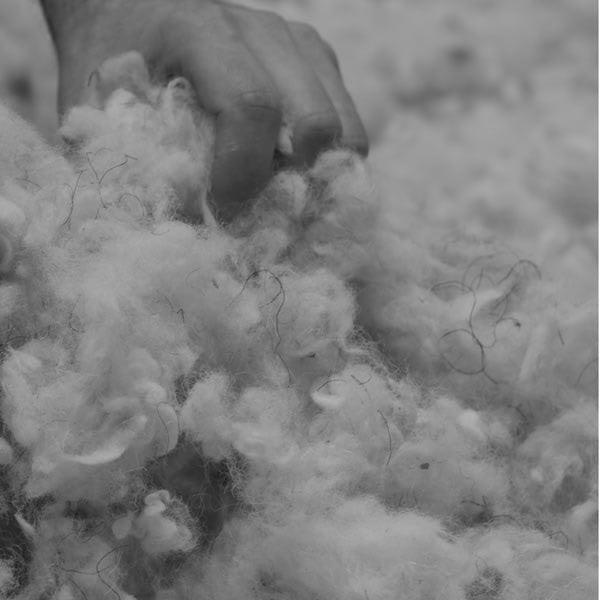
The benefits of sheep’s wool are too often overlooked. Its natural characteristics give wool mattresses, mattress toppers, futons, duvets and pillows remarkable qualities. Sleeping on a wool mattress means creating the right conditions for optimal sleep.
The wool used in bedding comes from the fleece of certain sheep breeds whose characteristics are particularly well suited to sleep.
It is a soft, crimped fiber. We have listed the many qualities of this age-old material here.
Wool also has the advantage of being a natural, noble material.
Sheep’s wool offers four key benefits when used in mattresses.
Its fineness, crimp, softness, flexibility, elasticity, strength and warmth make wool an excellent bedding material.
Sleeping naturally
A wool mattress lets you sleep without chemicals that could interfere with the quality of your rest, thanks to wool’s natural characteristics.
Wool’s first defining quality is that it is a natural fiber:
- renewable
- recyclable
- durable
- biodegradable
- local
Using wool in bedding creates a sleep environment free of harmful substances, helping you enjoy peaceful, restorative rest.
We sleep better on natural materials that respect the sleeper and contain no volatile organic compounds (VOCs), harmful substances or flame retardants, which contain endocrine disruptors.
Sleeping protected
Sleeping on a wool mattress is like sleeping in a cozy cocoon, protected from temperature changes in the bedroom by two essential properties that occur naturally in wool:
- thermal insulation
- temperature regulation
What makes these properties especially beneficial for sleeping comfort is that the large volume of wool filling the mattress allows both effects to work together.
Because wool insulates and adapts to changes in temperature, it keeps sleepers warm when it is cold and cool when temperatures rise. Wool helps maintain a consistent temperature throughout the year and protects you from the cold in winter.
Its breathable, absorbent fibers regulate the moisture released by the body, creating a healthy sleep environment without a buildup of odors, even if you perspire at night. They also wick away water vapor from perspiration to prevent overheating in summer.
This provides effective protection from both heat and cold, maintaining a healthy, comfortable temperature for cozy sleep.
With regular care, wool helps regulate body temperature during sleep so that you can rest more comfortably.
The bed therefore feels warm in winter and cool in summer.
It is not air conditioning, but the wool still stays cool.
In practical terms, wool’s moisture-regulating properties keep you from lying in your own perspiration in summer.
Contrary to its undeserved reputation, wool does not make you overheat. It regulates body temperature remarkably well!
We sleep better surrounded by the insulating and temperature-regulating qualities of sheep’s wool.
Flexible comfort
A wool mattress provides flexible support that distributes pressure points.
Wool acts as a soft, natural spring that follows every curve of your body, even as you move.
Wool has remarkable resilience that quietly supports your back, without the memory-foam marketing claims that bedding brands often use to inflate mattress prices.
The wool in a mattress compresses under the sleeper’s weight much like memory foam. Unlike memory foam, however, it springs back into place as soon as the sleeper moves, leaving no lasting impression.
To learn more about this quality of wool, read our detailed guide to the pressure-responsive benefits of wool mattresses.
If you are considering a memory-foam or polyurethane mattress, a viscoelastic foam mattress or a latex mattress is not your only option. Wool mattresses have compelling qualities of their own.
We sleep better when our mattress adapts to every movement and position.
Sleeping peacefully
A wool mattress promotes peaceful sleep.
Wool is a soothing fiber that can help you sleep better.
This is because:
- It carries less electrical charge than synthetic fibers. Wool is one of the materials least likely to generate static electricity.
- It does not promote mold growth.
- It traps very little dust.
We sleep better when the body’s natural processes are protected.
A few practical aspects
Sheep’s wool is naturally:
- flexible and lightweight
- elastic
- wrinkle-resistant
- easy to care for, with self-cleaning properties created by scales that open and close as temperature and humidity change.
- antistatic
- fire-resistant (with very low flammability). Wool fibers therefore meet most flammability standards without chemical additives
Light fiber
Wool is one of the lightest natural materials, making the mattress easier to carry and move when you make the bed or clean it.
With a density of 1.32 to 1.35 g/cm3, wool is lighter than most other natural materials:
- cotton (1.51 g/cm3)
- linen (1.4 to 1.52 g/cm3)
- hemp (1.48 g/cm3)
Easy to care for
Wool requires little care.
Learn more about caring for and cleaning a wool mattress.
Easy care also means using less water, electricity and cleaning products, which reduces environmental impact.
Antistatic fiber
Its ability to retain moisture means that it attracts and traps very little dust.
It is also one of the materials least likely to generate static electricity.
It produces less static electricity than other fibers, so it attracts and retains less dust.
Wool is therefore a healthy material.
All of this makes it easier to care for.
Is wool good for a mattress?
Yes, wool is excellent for a mattress: it regulates temperature naturally, absorbs moisture and promotes deeper sleep.
- Temperature regulation: keeps you warm in winter and cool in summer, even in humid conditions.
- Comfort: reduces pressure points.
- Durability: a strong, recyclable natural fiber.
In conclusion: the benefits of sheep’s wool for mattresses
Wool is a healthy, natural fiber and a fully renewable, biodegradable and recyclable material.
Wool’s remarkable qualities make it ideally suited to mattress making.
Wool has stood the test of time and has been part of the story of mattresses from the beginning. As far back as Ancient Rome, the earliest mattresses were already filled with wool, among other materials.
Since the 18th century, the benefits of sheep’s wool have made it an ideal fiber for mattress making.
It is eco-friendly, renewable, self-cleaning and produced locally, supporting healthy sleep. Its properties also make it possible to refurbish a wool mattress.
It is also worth noting that some characteristics vary between sheep breeds.
These benefits also depend on using untreated virgin wool, as Le Briand, a wool mattress maker, does.
Wool processing is an integral part of the value chain for a handmade French mattress. It must use healthy processes that respect animal welfare.