
Wool Mattress Care and Cleaning Advice
Published:
Updated:
Author: Le Briand Mattress Makers
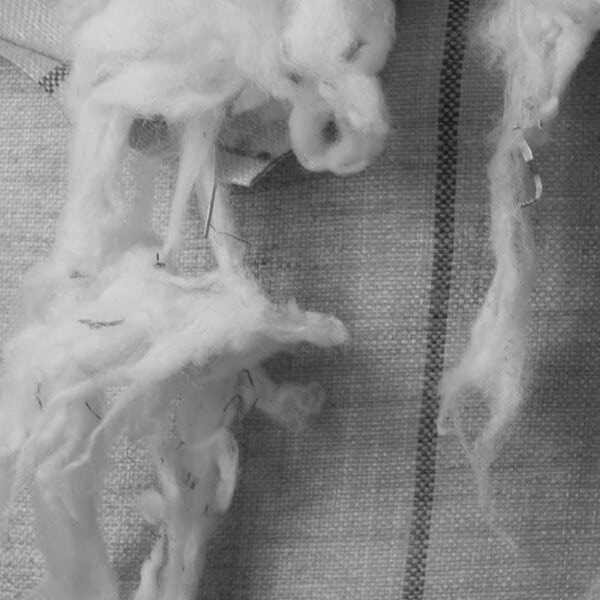
Choosing this type of bedding raises a few questions: how should you use a wool mattress properly? How do you care for a natural mattress? How do you clean a wool mattress?
Like a good pair of shoes, a traditional wool mattress needs, and deserves, special care to preserve its comfort and extend its life.
If you follow the guidance below on use, cleaning and refurbishment, your mattress can last more than 50 years, retain all its qualities and continue to provide an exceptionally healthy place to sleep.
Here are a few care recommendations to follow from the first days of use:
Care during the settling-in period
If you are not used to sleeping on handmade, natural bedding, we will guide you through the transition and help you understand what it involves. You will see that there is nothing complicated about it!
The settling-in period, and the care it requires, begins as soon as the bedding is installed. Our work is complete, and yours begins as you get to know this living, responsive material and develop new habits around it.
This period covers the first 4 to 8 weeks of use. Its length mainly depends on the sleepers’ weight, how much of the mattress surface is used at night and how regularly the mattress is turned. A guest mattress will naturally take longer to settle in because it is used less often.
During the first few weeks, simply sleeping on the mattress gradually settles the filling into place.
This period is therefore important: it allows the filling to settle evenly throughout the fabric casing and completes the final shaping of the mattress.
You will need to turn the mattress regularly.
Why should you turn your mattress?
Turning your mattress regularly helps maximize its comfort and extend its life. It allows you to:
- help the wool settle evenly after carding, when it is especially lofty upon delivery.
- prevent uneven compression.
- maintain an even loft so the mattress supports the sleeper properly.
This advice applies more generally to all types of mattresses.
Regardless of whether a mattress is said to have a summer side and a winter side, proper care means rotating it from left to right and head to foot as regularly as possible.
Always sleeping on exactly the same area will eventually distort the mattress structure, whatever filling materials it contains.
Turning also allows it to air properly.
How should you turn your mattress?
Alternate between rotating the mattress from head to foot and flipping it from one side to the other. Do one the first time, then the other the next time.
To make handling easier, we always add four handles, with two on each long side.
How often?
Once a week
If you feel able to turn it more often, the extra movement will help the wool retain its loft.
Once the settling-in period is over, it is important to keep up this habit. You will find the schedule that works for you, and turning the mattress will become part of your routine, allowing you to rediscover the comfort of your bed each time.
For example, you can turn it every time you change the sheets, or every other time.
As a general guideline, we recommend turning it at least once a month. Your mattress, and your own comfort, will tell you when it needs to be turned. A relationship develops between you and your mattress, so pay attention to how it feels!
Air the room containing the wool mattress every day
To care for your natural bedding, remember to air the room where it is kept for around 20 to 30 minutes each day.
In the morning, your wool mattress lets you go for the day. It has done its work through the night, supporting, embracing and even absorbing you.
Then it has a day to breathe: it releases the night’s moisture, freshens up and quietly regains its loft until nightfall, ready to welcome you again with its tufts restored.
How often?
Every day if possible, or at least as regularly as you can, pull back the duvet to open up the bed and open the window. Even half an hour is helpful.
Benefits
- dispel nighttime odors by refreshing the air in the bedroom
- limit the spread of dust mites
- release moisture and nighttime perspiration absorbed by the wool in your mattress
- help the mattress regain its resilience and loft as it dries
One of wool’s natural properties is its ability to absorb moisture from the surrounding air and from nighttime perspiration.
This simple habit allows the bedding to dry and the room to air. Along with vacuuming the room regularly, it remains the most effective way to combat dust mites !
Fighting dust mites
Like all bedding, a wool mattress is not immune to dust mites.
Dust mites thrive at a temperature of 25°C and 70% humidity. Keeping the room cool and limiting humidity makes it harder for them to multiply.
As with all bedding, effectively controlling dust mites requires you to:
- keep your bedroom cool, at around 18°C
- change and wash sheets and bed linens frequently
- vacuum regularly
- take the mattress outside if possible, beat out the dust and leave it exposed to sunlight or cold air
It is also best to limit dust traps such as ornaments and stuffed toys, and to keep pets out of bedrooms.
Protect your mattress with a fitted sheet
Protect your mattress with a mattress pad or protector, ideally made from cotton such as heavy brushed cotton or cotton flannel for greater breathability. If each protective layer is made from natural, breathable materials, you will continue to enjoy wool’s benefits!
The fitted sheet goes on top. Wash all these layers regularly to protect the mattress surface from accidents, odors, stains and the spread of dust mites.
Do not sit on the edge of the bed
Ideally, you should avoid sitting on the edge of the mattress for too long, unless you distribute that use along the entire perimeter!
This type of mattress is not a uniform block like a layer of foam. The edge of a wool mattress naturally responds to uneven weight, and prolonged pressure in one place could create a hollow along the side.
Cleaning a wool mattress
If a stain occurs, clean the affected area of the wool mattress with:
- soapy water, followed by rinsing and air-drying, taking care not to rub the wool.
- terre de Sommières clay
- a steam cleaner
- baking soda with tea tree essential oil.
If the mattress needs more extensive cleaning, or if it has compressed after several years of use, entrust it to a mattress maker to have it refurbished.
How do you wash the wool in a mattress?
Like any product designed to last, a wool mattress benefits from regular servicing. Mattress makers call this process refurbishment.
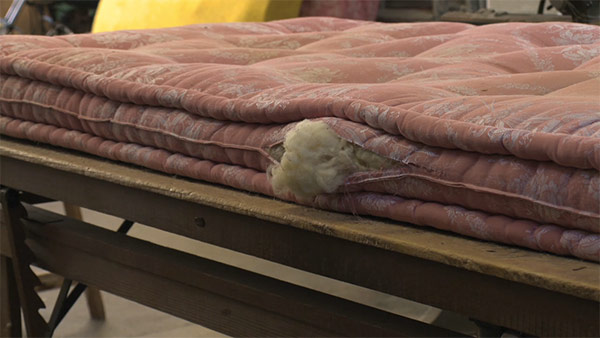
For a mattress that has been cared for regularly, this process takes place every 8 to 10 years. A wool mattress can be used for around ten years before each refurbishment.
It is carried out by a skilled mattress maker, who will explain how the wool in a mattress is cleaned.
This process involves remaking the mattress so that it comes back from servicing like new. Wool can be reused again and again. The main refurbishment steps are:
- remove the wool from the mattress
- run the wool through the carding machine to remove all dust and restore its loft
- fill a new fabric casing with the refreshed wool
In conclusion: using, caring for and cleaning a wool mattress
By caring for, cleaning and periodically refurbishing your natural wool mattress, you give it an exceptional life span and can keep it for the rest of your life.